Why I Don't Use Sanskrit in Class

I’m a white gay man. I have nothing to lose from staying quiet and nothing to gain from stirring the debate.
I know what it feels like in my body to be told the divine isn’t for you.
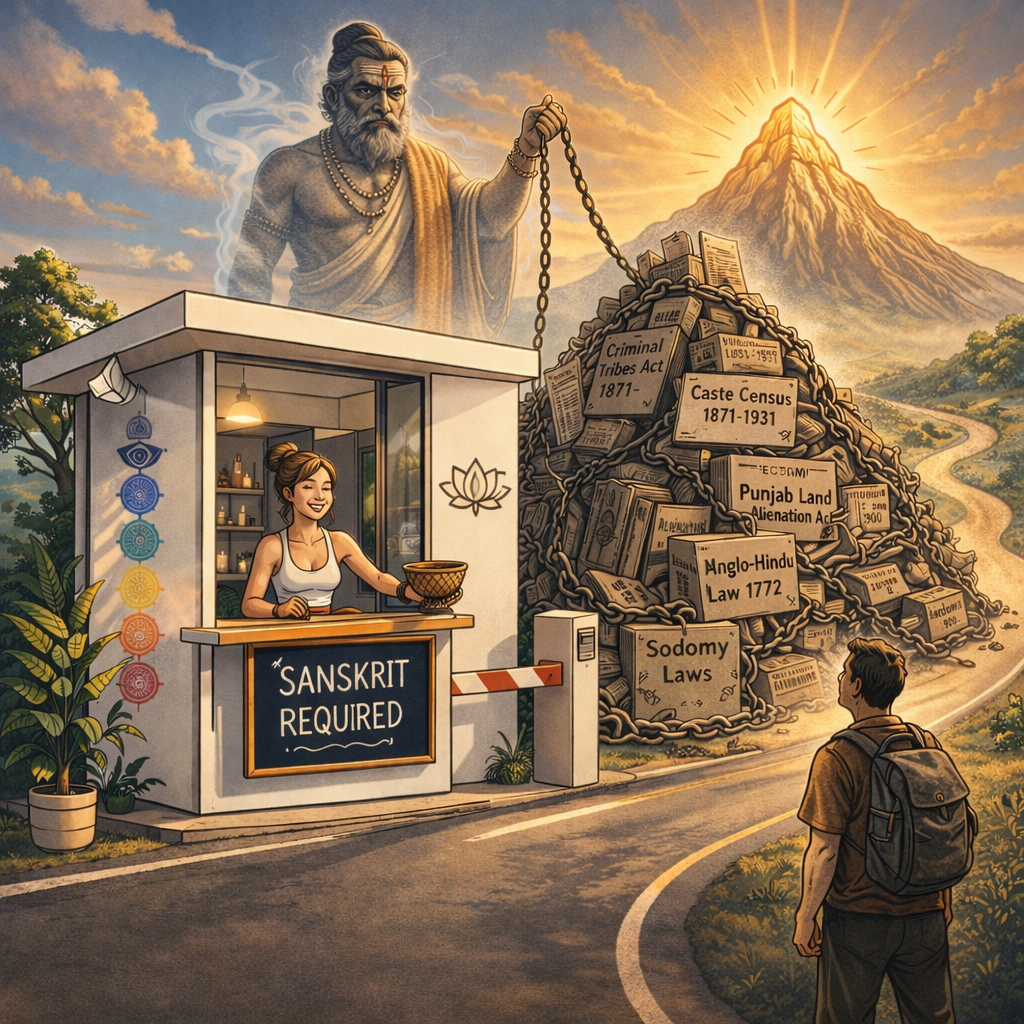
I refuse to run a toll booth on the road to liberation because that’s what the market expects from yoga.
Here’s what I mean — and why every teacher in this space needs to sit with it.
What Is Brahminism?
The caste system still divides Hindu society into a rigid hierarchy of social and spiritual rank. At the top sit the Brahmins — the priests and scholars who controlled access to sacred knowledge, sacred texts, and sacred language. Below them are the Kshatriyas, the rulers and warriors. Below them are the Vaishyas, the merchants and traders. At the bottom of the ladder are the Shudras, the laborers and servants. And then, outside the system entirely — not even on the ladder — are the Dalits, formerly called “untouchables,” who were considered so beneath the system that contact with them was treated as spiritual pollution.
Caste discrimination was constitutionally abolished in India in 1950. Dalits are still being killed for violating it.
Brahminism is the ideology that keeps that structure in place. It concentrates spiritual authority in the hands of the priestly class and uses control of sacred language and sacred knowledge as the mechanism of that control. If you can’t access the texts, you can’t access liberation. The priest stands between you and the divine — and the priest decides who gets through.
Sanskrit was the lock. The Brahmin class was the only one authorized to hold the key.
That is the system Western yoga imported.
What the Market Asks You to Perform
Walk into almost any yoga studio in America and you’ll find the same costume. A Sanskrit pose name dropped into the flow. A chakra diagram on the wall. Maybe a spiritual reference that nobody in the room could trace back to its source. The teachers performing it often don’t know what they’re actually doing — and the studios prefer it that way. Too much India makes the clientele uncomfortable. So the culture gets curated down to whatever is exotic enough to feel elevated but familiar enough not to turn anyone off.
The practice is real. The costume is not.
The market built this because it sells. Sanskrit signals depth. It signals lineage. It signals that you are receiving something ancient from someone who has earned the right to transmit it. Every word you can’t understand reinforces the idea that the teacher has access to something you don’t — yet.
That is not transmission. That is a toll booth.
What Sanskrit Actually Is
Thenmozhi Soundararajan’s The Trauma of Caste argues that Sanskrit did not become a weapon of caste oppression over time. The evidence she presents points to the opposite. Sanskrit was explicitly codified as a weapon of control from its earliest institutional use. It was designed to exclude.
Soundararajan documents the punishments laid out in the Brahmanical legal tradition — including the Gautama Dharmasutra, which decrees that if a Dalit dares to hear a Vedic teaching, their ears should be filled with molten lead. If they repeat it, their tongue cut off. If they learn it, their body ripped apart. Soundararajan’s argument is that this was not a corruption of something purer. The exclusion was the design.
This matters because most defenses of Sanskrit in Western yoga rest on a corruption narrative — the idea that we simply need to return to a purer use of the language. Soundararajan does not give us that exit. The caste function of Sanskrit is not a bug. It is the original feature.
What she gives us instead is more useful: the practice itself was never housed in the language. The practice lives in the body. It always has. Sanskrit’s function was to build a wall between people and their own embodied access to the practice. Control the language, control liberation itself.
Sanskrit was not incidental to that system. It was load-bearing. The lock on the gate of liberation, controlled by the only people authorized to hold the key. But the system it served was always bigger than a language. It was a machinery of hereditary oppression — the oldest and most sophisticated in human history — and the British colonial empire didn’t dismantle it when they arrived. They picked it up, formalized it, and carried its logic across the world.
The Legacy We’re Still Living With
The transatlantic slave trade was built on the same foundational logic. Human beings — kidnapped, chained, and shipped across the Atlantic — were assigned a permanent hereditary status at the moment of arrival. Not by what they did. Not by what they believed. By what they were born as. Their bodies became property. They could be sold, separated from families, branded, and traded. Children inherited the status of their parents automatically.
These were not separate inventions. They were the same architecture — someone fixed at the bottom by birth, their body belonging to the hierarchy, their humanity the cost of someone else’s order. The British colonial empire didn’t need to copy one system to build another. They were the same empire, operating from the same template, on different continents at the same time. Isabel Wilkerson, in Caste: The Origins of Our Discontents, argues that what was built in colonial America was not merely racism — it was a caste system. The concept of race itself is only four or five hundred years old. It was invented as a tool, at the moment the hierarchy needed a justification, to mark who belonged at the bottom permanently. The machine required a logic. The logic was already there.
British colonial administrators didn’t just observe the caste system — they institutionalized it. The Criminal Tribes Act of 1871 declared that all those who belonged to certain castes were born with criminal tendencies. Entire communities presumed guilty by birth, restricted in movement, their children separated from them and held in penal colonies without conviction or due process. By 1931, the colonial government had listed 237 criminal castes and tribes in the Madras Presidency alone. At Indian independence, 13 million people in 127 communities were still subject to it. The Punjab Land Alienation Act of 1900 created an “agricultural tribes” category — only members could buy or sell land — locking caste directly into property law. The ten-year census, run between 1871 and 1931, converted fluid and regionally diverse social identities into fixed hereditary categories that could be administered, taxed, and controlled. And the East India Company appointed Brahmin pandits as official legal advisors to British courts, enshrining upper-caste interpretations of Hindu law into the colonial legal framework itself. The system Sanskrit was built to serve didn’t stay in India. It was adopted, formalized, and exported.
The same colonial period produced parallel structures elsewhere. In the American South, Jim Crow laws built a legal racial caste system — separate schools, separate transportation, separate facilities — from the 1870s onward, and the Supreme Court upheld it in Plessy v. Ferguson in 1896. Soundararajan argues that the British colonial model of racialized hierarchy, refined through the administration of caste in India, informed the architecture of American racial law.
At the same time, the British were exporting the criminalization of sexuality across their empire. Section 377 of the Indian Penal Code, imposed in 1861, punished what it called “carnal intercourse against the order of nature” with up to life imprisonment. Before British rule, homosexuality was not illegal in India. After Section 377, versions of that law spread across dozens of British colonies. The Criminal Tribes Act went further, classifying hijras — India’s transgender community — as a criminal tribe, subject to arrest simply for appearing in public. The same decades. The same machinery of colonial control. Different targets.
United States v. Thind (1923) is where the logic becomes explicit. Bhagat Singh Thind, a Punjabi Sikh man who had served in the U.S. Army, was seeking naturalization. The Naturalization Act still restricted naturalization to “free white persons” — language carried over from 1790 that had never been fully updated. His argument was straightforward: we built this system of racial hierarchy. We have always been at the top of it. Your system operates on the same logic. Recognize us at the top of yours. He claimed that as a person of high-caste Aryan lineage, he was racially Caucasian — and therefore legally white. His lawyers submitted to the Court that “the high-caste Hindu regards the aboriginal Indian Mongoloid in the same manner as the American regards the Negro, speaking from a matrimonial standpoint.” The caste system offered as proof of belonging at the top of American white supremacy. The original architects of the hierarchy, presenting their credentials to the latest version of it.
The Supreme Court rejected the argument. But the logic was already inside American racial thinking.
This is not abstract to me. Prior to Illinois’s repeal in 1961, every state in America criminalized sodomy. That law traced its lineage directly to the English Buggery Act of 1533 — the same legal tradition the British used to build Section 377 in India, the same template they exported across their empire. The United States didn’t strike down its remaining sodomy laws until Lawrence v. Texas in 2003. Gay marriage wasn’t recognized nationwide until Obergefell v. Hodges in 2015. These aren’t ancient history.
Hierarchy-based oppression is a soul wound at the heart of modern yoga. You cannot fix it by continuing to use the language that was designed to perpetuate it. Yoga claims to be a practice of liberation. That claim cannot coexist with performing the system that produced the wound.
How Western Yoga Recreated the Structure
The teachers who exported yoga to the West — Iyengar, Jois, Sivananda, Krishnamacharya — came from Brahmin or upper-caste backgrounds. They transmitted a version of the tradition that quietly laundered caste history from its own foundations. The karma theology that told Dalits they deserved their suffering because of past-life sins was smoothed into “follow your bliss.” The Sanskrit that was used to exclude the caste-oppressed was repackaged as the universal language of an ancient wisdom tradition.
Commercialization then replaced birth as the gatekeeping mechanism. The structure is the same. The criteria for admission changed from hereditary caste to economic access. The knowledge toll is simply denominated in dollars instead of birth.
The tradition being honored through Sanskrit is not even fully Indian. Scholar Mark Singleton’s Yoga Body makes the case that modern postural yoga is largely a twentieth-century synthesis. Krishnamacharya drew from Scandinavian gymnastics, British Army calisthenics, the bodybuilding tradition, and the Indian YMCA. Modern postural yoga is a global hybrid. Performing Sanskrit as the sacred language of an ancient and purely Indian tradition erases most of what actually built the practice.
The Vatican II Parallel
For most of Catholic history, Mass was conducted exclusively in Latin — a language most congregants could not speak or read. The priest stood between the people and the sacred text, mediating access. In 1962, the Second Vatican Council moved the Mass into the vernacular. The reasoning was simple: the work of the priest is to serve the congregation’s access to the sacred, not to guard it.
Latin actually had a stronger historical claim to authority than Sanskrit ever did. It earned its universality organically — the language of the Roman Empire, of medieval scholarship, of Newton, of Linnaeus’s biological taxonomy, of medical terminology still in use today. Its reach was earned through centuries of genuine cross-cultural use. The gatekeeping came later — a corruption of something that started as a common tongue.
Sanskrit functioned as a transregional language of philosophy and ritual across Hindu, Buddhist, and Jain traditions — but access to it was tightly controlled, and it never functioned as a shared vernacular across social classes. It was constructed from the beginning as a priestly register, deliberately elevated above the languages ordinary people actually spoke. The great works of Hindu philosophy were written in Sanskrit — but that was precisely the point. They were written in a language only the priestly class could read, ensuring that access to those works required a Brahmin intermediary. The sacred texts were in Sanskrit so that the sacred texts were theirs. It functioned as a gate within the Brahmanical system.
When Western yoga treats Sanskrit as a noble universal tongue, it is performing a legitimacy Sanskrit never earned. Latin fell from a height it genuinely occupied. Sanskrit in a Western yoga room is performing a universality it never actually had, in service of an exclusion it was always designed to maintain.
Vatican II was not a defeat for the tradition. It was the tradition returning to its purpose. The same correction is available to yoga.
The Defenses Don’t Hold
“The sounds themselves are sacred.”
Vibrational sound affects the nervous system. Research suggests OM chanting may promote effects similar to vagal stimulation — parasympathetic regulation, a quieting of the nervous system. This is physiology, not mysticism, and the discovery deserves credit.
But discovery is not ownership of the phenomenon. Gregorian monks found it through Latin chant. Tibetan monks through overtone singing. Indigenous traditions through drumming. A cat’s purr triggers bone regeneration through frequency. The vagus nerve does not have a Sanskrit preference — it responds to resonance. If the sacredness of these sounds cannot be exclusive to one language’s phonemes, then the argument is about authority rather than the body. Which is the gate operating under a different justification.
“There’s no English equivalent.”
Every deep tradition has words that resist translation. The Greek word agape has no direct English equivalent either — it describes a love that is unconditional, selfless, and transcendent in a way that “love” alone doesn’t capture. Humanity has always solved this the same way: you teach around the word. You describe the concept. You give people the full experience of it until they feel it in their bodies — and then the word becomes shorthand for something they already know rather than a password to something they haven’t been given.
Using untranslatability as justification for dropping a Sanskrit term into a sixty-minute flow class is not honoring the depth of the concept. It is using untranslatability as a shield for not doing the harder work of actual transmission. That is either laziness or lack of depth. Neither is a defense.
“Sanskrit unifies practitioners globally.”
The students for whom this universality is practically relevant — moving between studios in Bali and Brooklyn and Barcelona — are among the most economically privileged people on earth. This is not a universal. It is a club whose membership fee includes the cost of acquiring the shared vocabulary.
A student who has practiced can follow the body of a teacher anywhere in the world without a shared spoken language. The same is true of Catholic mass. A practitioner can walk into a Mass in rural Portugal with no Portuguese and still know exactly where they are in the liturgy — the gestures, the postures, the rhythm, the moment of communion. The body knows the ritual. None of it requires a shared vocabulary. The practice travels in bodies. If the practice truly lives in the body, Sanskrit was never the unifier. It was always ornamental. And ornaments have owners.
“It honors the lineage.”
Which lineage? The lineage of Sanskrit in yoga is the Brahmin lineage that used it to enforce caste, to exclude Dalit practitioners from spiritual knowledge, to make liberation itself a hereditary privilege. Performing that lineage in a Western studio is not reverence. It is the perpetuation of the mechanism of exclusion under the guise of respect.
The lineage worth honoring is the full one — the Indian philosophical roots, the people violently excluded from those roots, and the Western physical culture that significantly shaped the practice we actually teach. Sanskrit honors none of that. It signals ancient Indian origin while erasing everyone else.
“Not using Sanskrit is itself cultural appropriation.”
This defense deserves serious engagement because it’s the most structurally honest of the arguments. If yoga belongs to Indian culture, the reasoning goes, stripping its sacred language is just another form of taking the practice while discarding what made it meaningful.
The problem is it assumes a unified Indian culture with a unified claim to Sanskrit. That assumption doesn’t survive scrutiny. Modern postural yoga is already a twentieth-century hybrid — Krishnamacharya drew from Scandinavian gymnastics, British Army calisthenics, and the Indian YMCA. The claim that Sanskrit is the essential container of yoga becomes unstable once you recognize that the practice itself was assembled from multiple sources.
More importantly: whose Sanskrit?
Dalit practitioners were violently excluded from it for centuries. They did not bequeath it to Western yoga. The Brahmin class did. Performing Sanskrit in a Western studio to “honor Indian culture” is not honoring all of Indian culture. It is honoring one group’s claim to authority over it.
The people most often cited in conversations about cultural appropriation were historically excluded from the language being “preserved.”
“Students want it.”
The desire is legitimate. The container is wrong. Sanskrit belongs in workshops and teacher trainings where there is time and space to teach its full history honestly — who built it, who it excluded, what it cost. In that container it becomes a door left open for those who want to go deeper into something already fully given to them. That is the opposite of a gate. A gate is what you must pass through to get the basic thing. An open door is what you find after you already have it.
“Reclamation.”
Reclamation belongs to the community that was harmed. A Western yoga teacher performing Sanskrit as an act of reclamation is not liberation. It is appropriation wearing liberation’s language. The Sanskrit in my classroom would not be rescued from Brahminical gatekeeping. It would teach those words to the next generation. Keeping the ghosts alive.
What I Do Instead
The teacher’s job is honest translation, not gatekeeping. The body was always the universal language. Sanskrit is the toll booth on the road to it. I don’t run a toll booth.
I also want to be clear about what I’m actually teaching. My practice draws from a wide range of traditions — somatic work, breathwork, nervous system science, Stoic philosophy, tantric frameworks, Western psychology, and the movement traditions that built modern postural yoga. None of these belong exclusively to the Brahmin class. None of them require Sanskrit to transmit.
And here is something worth sitting with: yoga, as Patanjali actually wrote it, is not primarily about the physical practice. Of the 196 sutras in the Yoga Sutras — the foundational philosophical text of classical yoga — asana is addressed in just three of them. Three sutras out of a text concerned with how to still the fluctuations of the mind, how to live ethically, how to move toward liberation. As the Internet Encyclopedia of Philosophy puts it, the presentation of yoga as primarily or exclusively physical posture “is essentially a modern Western phenomenon and finds no precedent in the premodern Yoga tradition.” The poses are preparation for meditation. The tradition is a philosophy for how to live your life on a spiritual journey. That is what I teach.
What I teach also draws from a tradition far richer and far more democratic than the Brahmin lineage Western yoga performs. The yogic philosophical traditions of India are not the property of the priestly class. Some of the most profound spiritual teachers in this history were explicitly anti-caste — and they said so loudly, in the languages ordinary people actually spoke.
The Bhakti movement, which began in Tamil Nadu in the sixth century and spread across the subcontinent over the next thousand years, was one of the great counter-caste movements in human history. Its teachers taught that devotion, not birth, determines spiritual worthiness. Salvation, which the Brahmin class had claimed was available only to the upper three varnas, was available to everyone. These teachers didn’t write in Sanskrit. They wrote in Tamil, Kannada, Hindi, Marathi, Punjabi — the languages their people actually spoke — deliberately bypassing the gatekeeping language of the priestly class.
The saints who carried this tradition were not Brahmins. Kabir, one of the most celebrated mystic poets in Indian history, was from a Muslim weaver family — a low-ranked caste. Ravidas, whose verses appear in the Sikh scripture the Guru Granth Sahib, was a cobbler — a Dalit. He wrote: “O people of the city, everyone knows I am a cobbler by trade and tanner by caste.” Namdev was a tailor. Chokhamela was from the Mahar caste — untouchable — denied entry to the Vitthal temple at Pandharpur, and wrote his devotional poetry from outside the doors. Tukaram was from a low caste and was regularly humiliated by priests who told him his birth disqualified him from the sacred.
The Nath tradition, which gave us much of what became Hatha yoga, was equally explicit. Gorakshanath, one of its founding teachers, directly rejected the four-varna system. The Naths recruited disciples regardless of caste or religion. During British colonial rule, the census classified Nath yogis as a low-status caste. The very lineage through which the physical practice of yoga traveled was a lineage of people the Brahmin class looked down upon.
The Sant tradition carried this further still. Teachers like Kabir and Ravidas composed deliberately in vernacular languages to bypass what scholars call “the exclusivity of Sanskrit-dominated religious discourse.” This was not a stylistic choice. It was a political act. They were building a path to liberation that the priestly class could not lock.
This is the lineage I’m actually teaching from. These are the people who built the devotional heart of what we call yoga philosophy. They are not the people Western yoga is honoring when it drops Sanskrit into a sixty-minute flow class. Not Brahmin authority dressed up as ancient wisdom. The lineage that said authority itself was the problem.
In my classes, I translate. I teach the philosophy in the language my students actually speak, drawing from whatever tradition gives the clearest path to the thing underneath. Sanskrit isn’t banned from my practice — it belongs in workshops and teacher trainings where the full history can be taught honestly, including who it excluded and who built something better without it. In that container it becomes a door left open, not a gate you have to pass through.
That is the opposite of how this system was designed to work. That is the point.
The Minstrel Parallel
The market asked me to perform a tradition I didn’t build, in a language designed to exclude the people who built it, for an audience that doesn’t know the difference. That is the definition of a minstrel.
The minstrel show was one of the most destructive forces in American history for Black advancement. Performers took the surface markers of Black culture, exaggerated them, stripped them of dignity, and performed them for white audiences at a profit. The performers got paid. The source community got further buried. The culture was made consumable by removing everything that made it dangerous.
The structure of Western yoga is the same machine.
A Western teacher takes the surface markers of Indian spiritual culture — Sanskrit pronunciation, the aesthetic, the symbols — performs them for a predominantly white Western audience, and calls it reverence. The Dalit practitioners who were violently excluded from that tradition for centuries are invisible in the transaction. The culture gets curated to its most consumable elements. The symbol stays. The people disappear.
As a white man, I am in the demographic most likely to benefit from this performance and least likely to be held accountable for it. That is exactly why I’m the one saying it.
The Correction Is Past Due
I’m a white gay man with nothing to gain from saying this. I’ve done the reading. I’ve felt the cost in my own life. I know what it means when a system decides your body doesn’t belong.
Every longstanding injustice has been defended by people who found the correction too disruptive, too costly, too threatening to the community organized around it.
The Latin mass congregants resisted the vernacular. Vatican II was not a defeat for the tradition. It was the tradition returning to its purpose. The Mass didn’t become less sacred when it moved into the vernacular.
The same correction is available to yoga.
The difficulty of correcting a longstanding injustice is not an argument against the correction. It is proof the correction is necessary.
How can we claim to dismantle oppression-based systems while continuing to perform one?
I’m not a minstrel. I’m a yogi.
The difference matters.